3 episodes taggedApproximate match across all podcasts
Home/Tags/BUILD SKILLS

BUILD SKILLS

All podcast episode summaries matching BUILD SKILLS — aggregated across every podcast we track.

3 episodes · Page 1/1

Quotes & Clips tagged BUILD SKILLS

31 on this page
Apr 21

Gen Z is pivoting to trade roles as AI-resilient career insurance

a real affinity now towards trade roles... especially kind of Gen Z sees as a much safer option. What do you mean trade uh like like firstline jobs um you know typical like trade roles not office jobs and they see those as more resilient in an AI world. These are the types of jobs that AI probably won't take. Uh so we're seeing more affinity towards that as well.

Ryan Roslansky

Cursing at the AI or saying your boss is mad actually works

That can work, but I find that the more successful one is, is it's either cursing a little bit, in the prompt. I I, you know, am somewhat ashamed to admit that it that's extremely effective. But the more, common one I I use now is that my boss is mad at me, and it seems to work pretty well. It it kind of sympathizes with you, and it's it's it's kinda cute.

Alex Kern - engineer at Figma

A slash-ship skill automates preflight checks and CI babysitting

I have this slash ship skill that I wrote. I use it all the time, in my workflow. Often in order to get something into a large repo like the Figma repo, there's a lot of work that's involved in just making sure tests pass, making sure, all of the, like, preflight things are in order. And also then once it's pushed to, the repository, checking on CI and making sure that it correctly built and is all green so that I can actually merge it. Previously, I would have to kind of babysit these, you know, kind of processes, like, all the way at every single step.

Alex Kern - engineer at Figma
Apr 21

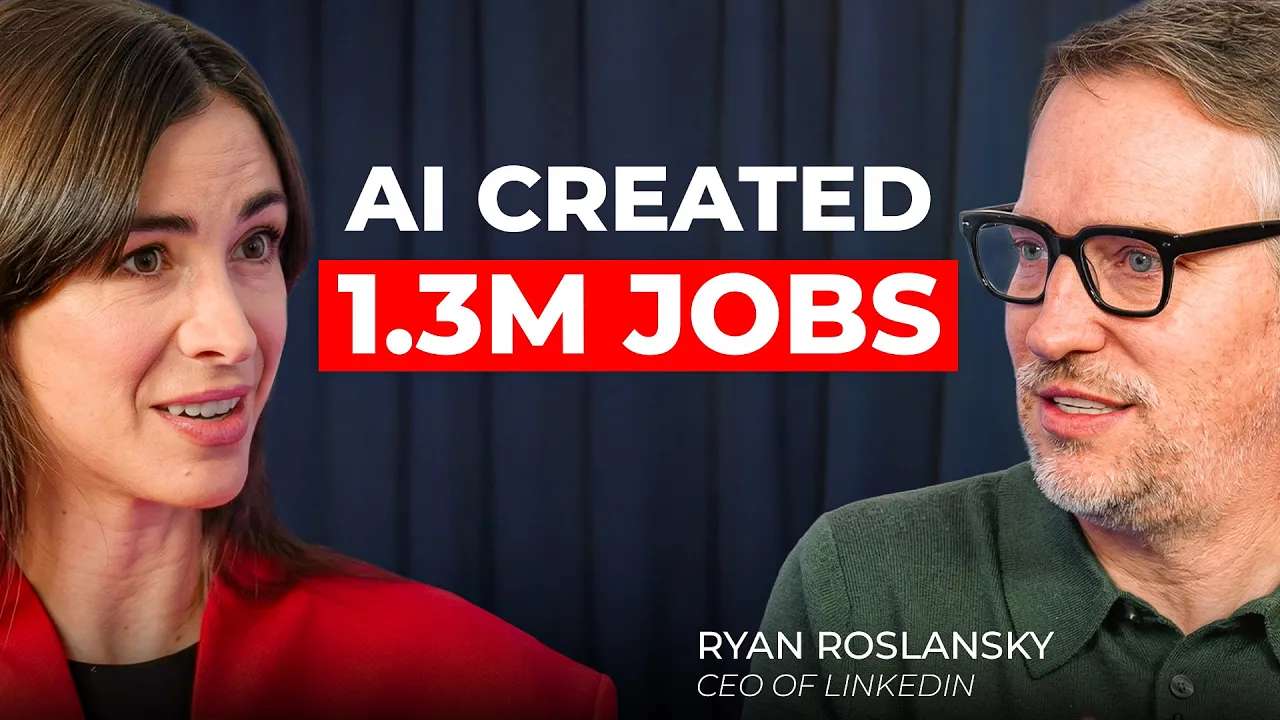
AI is currently creating millions of net new jobs rather than destroying them

As it relates to AI, we see something totally different. There's actually been almost, you know, 1.3 million brand new net jobs on LinkedIn for AI roles like data annotators. Um, over 600,000 new data center jobs uh exist on LinkedIn... at least in terms of what we're seeing in the LinkedIn data right now, AI is a net positive addition to the job market, not something that's detracting jobs.

Ryan Roslansky

Skills should be portable files not proprietary formats

For our skills are file based instead of, like, this complicated thing that exists inside a place somewhere that is, like, super proprietary. I'm really leaning into the idea of, like, it's all just files and folders, and that makes it very portable on its own right. The portability is just a file, it's just markdown, it's just text, honestly, right, like a text file words. The complete lack of structure, which means you don't need any kind of tutorial to write a skill, just like explain it to Claude the way you would explain it to me.

Felix Rieseberg - Anthropic Claude Cowork lead

Run five Claude Code instances in parallel from your terminal

I spend quite a lot of my time just sitting here inside of my terminal now. I do so much less. I think of the, like, what I used to have to do where I had to have a browser window open at the same time as having my code window open. So, I often have two, three, up to five maybe cloud code, instances running all at the same time, working on different aspects of the work that I'm I'm tracking.

Alex Kern - engineer at Figma

Direct manipulation beats prompting for precision design edits

I don't think we're there in general with, these kind of code tools in terms of the precision editing that you wanna do. And trust me, I I use the whole kind of landscape of tools to really see kind of where these workflows are going, and I think still the the gold standard for me is just being able to drag stuff around. And you can do a lot with a click that would take you a 100 words to kind of write and to, like, really precisely nail. Like, no one wants to prompt for the exact hex code or the the shade of yellow.

Gui Seiz - designer at Figma

Export every code state into Figma so designers see reality

Oftentimes, the code base gets way ahead of where the actual design file is, and there's states or workflows that just don't exist at all within the design file. So what I can do is say, send all five states. Sign up flow to click on. Now the agent's going to do is read my code base, understand what I'm referring to when I say those five states. And for each one of those, it's going to individually import that one by one into Figma such that the Figma document will then have all of those states laid out all side by side so that my design partner can work against against it.

Alex Kern - engineer at Figma

Execution is now cheap so build all candidates instead of memos

We used to live in this world maybe where you would take a product manager, and the product manager would go to a number of potential customers, and in this very low bandwidth way, would try to tease out what are the problems they're having. We internally at Anthropic are now probably much closer to the point where we're like, don't don't even write a memoir. Just like build like, let's build all the candidates very quickly. Like, let's let's just build all of them, and then pick the best ones.

Felix Rieseberg - Anthropic Claude Cowork lead

Pull production code into Figma via MCP to fix drift

Something that happens a lot is, the sources of truth diverge between design and code. So sometimes some things only really exist in a state in code, or you start working with a developer and you really, like, elevate what the thing was, the artifact that you originally supplied. Or sometimes, like, that just doesn't exist in code. You've inherited someone else's project from forever forever ago.

Gui Seiz - designer at Figma

Turn engineering wikis into installable skills for your team

Every engineering org that I've ever run has an internal Wiki that has that page, which is this is what you do before you push a PR and you get in everybody's way in the deploy pipeline. And every engineering team should go through their onboarding Wiki and pull every page out, every this is what you should do into a skill, and then give give access to that to their entire team. And so I think we're really shifted from this idea of, like, an SOP into a skill or a doc into a skill.

Claire Vo - host of How I AI
Apr 21

Seventy percent of professional skills will change by 2030 due to AI

the types of skills that are necessary for a specific role on LinkedIn have changed north of 25% you know over the last couple years alone. We expect they'll change by 70% by 2030 largely influenced by AI and new tools and new ways of doing these professions. So, um, you know, my, you know, I I often when I talk to people about what they should do with their career, it's it's less about where do you want to be in five years, and it's more about over the next few months, like what new skills do you want to learn?

Ryan Roslansky
Apr 21

Soft skills are a misnomer and are now more critical than technical ones

just as important on the other side are human skills curiosity creativity courage communication, uh, compassion, the ability to work with other people, the ability to sit down with someone and actually have a conversation. You can't just be mired in using technology in a bubble and be successful. Uh, in a lot of work settings, you have to be able to, you know, disagree and commit with someone... typically called soft skills. I think that's a misnomer. They don't you know soft kind of feels like it's less important. I think they're more important than ever.

Ryan Roslansky

Anthropic is genuinely worried about junior employee displacement

At Anthropic, as a group of people, we're deeply worried about the impact that the tools are going to have on the labor market, especially for junior employees, because I think it's only honest to say that when we talk about automating away a lot of the work that we personally find annoying, that we maybe think is not the best use of our time, in a lot of industries that kind of work would have been given to a junior or a entry level employee, right? And I think it's it's only it's only right to be really worried about that.

Felix Rieseberg - Anthropic Claude Cowork lead

Approve-every-command UX breaks down so sandboxing is the answer

I do think, it's maybe on us as like the honest trader to come up with something better than, oh, this is super safe, as long as it doesn't do anything. But if you want this to be useful, then you have to approve every single step of the way, and like computer use is a good example, the only way to make computer use on your host, like super safe, like really super safe, is probably if you approve every single action. You need to probably delegate, you need to be able to delegate and walk away and trust that this thing is not gonna mess.

Felix Rieseberg - Anthropic Claude Cowork lead

Use AI to dig up lost lore buried in old codebases

We have an internal service, for example, that I didn't know the origin of its name. And so I asked Claude to go and figure out based on the commit history, what the origin was, and it came back with a really good story, about, like, how that came to be. It got renamed multiple times that, you know, contributor has since left the company many years ago, so this was kind of lost in the ether. But now, now, all of this lore, honestly, from the company is actually, like, embedded inside of the code base, and, I can I can find it now?

Alex Kern - engineer at Figma

Simulated jobs could compress junior career learning curves

I have a solution for that, which you make them you create simulative jobs for them. So if you think about software engineering, when you're like a junior engineer, you work, like, one, two, three years. And in those three years, there's like maybe like a handful of moments where, like, you really learn something. I think now we can use AI in these models to actually, like, shortcut these careers and almost, like, simulate the early years of your work. In, like, one year, you basically got, like, three years worth of, like, projects and experience.

Alessio - founder of Kernel Labs

Linear design-to-code workflows have collapsed into fluid loops

It's definitely changed, our workflows, in a way that it's kinda really blown up what a workflow even is. Before, you know, for the the majority of our careers, we've had a very, like, linear agreed upon workflow where the where you increase fidelity as you go on. Right? Because it's really expensive to work in code, and it's really cheap just to trade ideas and sketch them out. But I basically collapsed that, and it's just as cheap to riff in code as it is to riff in design.

Gui Seiz - designer at Figma

Windows 95 runs inside JavaScript faster than many SaaS apps

This came out of a debate we had at work where people were, like, they often are in the end debating the merits of Electron and whether or not we should be building software in JavaScript, yes or no, and I still am very upset that I can run all of Windows 95 in JavaScript, and launch Microsoft Excel inside the virtualized JavaScript Windows 95 machine, and do things that I can do that entire chain faster than I can do a lot of other things in traditional SaaS applications. This is sort of like a performance rampage that I went on, so I mostly built this as a joke for some of my colleagues at Slack.

Felix Rieseberg - Anthropic Claude Cowork lead

Claude Cowork was built in ten days from existing prototypes

Internally, Anthropic is a very prototype demo first culture. We have a lot of like internal prototypes that don't reach the public, and what cowork actually became is like we sort of picked the right pieces out of the many prototypes that we had, right? And that's maybe also like I think an important qualifier whenever people mention this ten day number. I do think it's important to me to mention that we didn't start with scratch, there was a lot of stuff already happening.

Felix Rieseberg - Anthropic Claude Cowork lead

Electron ships Chromium because OS web views are not good enough

The reason to go with your own embedded rendering engine is because, and this is still true in 2026, the operating system rendering engines are not that good. They're just not that good. So if you're, say, a Slack, and you have a critical rendering bug in WK WebView and some of the other WebView options, your only recourse is to to tell your customer, oh, sorry, you're too poor, you didn't buy the latest MacBook. Unacceptable. So you sort of need to go down the stack and find the best rendering engine, then put it in your app.

Felix Rieseberg - Anthropic Claude Cowork lead

Give Claude its own VM like a real coworker

The analogy I've given my dad this morning, who is still, like, quite insistent on using chat, even for, like, coding things is, if you were a developer, and your employer told you that you don't need a computer, they're just gonna, like, send you emails with a code, and you send emails with a code back, Like, that maybe worked for patch files in the back, but that is not very effective. So what we can do with the VM is, because it's a Linux system, Cloud Code has more or less free reign to install whatever it needs to install.

Felix Rieseberg - Anthropic Claude Cowork lead
Apr 21

The concept of a linear career path is a data-backed myth

the reality is in the data there is no such thing as a linear career path. Like it's all over the place. So the more that people first and foremost recognize that you have to take your career into your own hands. There's no natural path that exists that you just get on, I think is is really really important.

Ryan Roslansky

Silicon Valley undervalues the local computer

I generally believe that Silicon Valley overall is undervaluing the local computer, and my default argument for that is always, how come you're all using MacBooks, and not like an iPad or a Chromebook? There's still value in having a local machine, and now when I think about clock as this entity that is supposed to be very useful to you, like it's tremendously useful to you, I think that entity needs to have access to all the same tools you have access to, otherwise it's going to be hamstrung in all these complex ways.

Felix Rieseberg - Anthropic Claude Cowork lead

AI shifts design work upstream to planning, downstream to craft

What's really interesting about, like, our our role with all of this is kind of really moved upstream. And we're in this really I find, almost decadent moment in time where before we had to be so conditioned on really sharp product decision making skill that would have happened, like, almost immediately. So now we're kind of actually at this point where more of the priorities can make it above the cut line. And, also, we can spend a lot more time in the planning stage. And so we do that, and then on the other side, we spend a lot more time in the craft because we can, because we can reach higher for ideas.

Gui Seiz - designer at Figma

More clips tagged BUILD SKILLS?

Get a daily email of the best quotes & audio clips from the top podcasts.

Subscribe for daily Quicklets