Deceleration increases risk of civilizational failure
“I think mathematically provably, having a decelerative mindset, and it's a general pattern of many subcultures of making yourself small, degrowth, and so on, it's actually negative, it gives you negative fitness, and actually accelerating your downfall as an organism. Whether it's a decelerative mindset at an organization level, in a company, at a national level, at an individual level, you're lowering your likelihood of being part of the future.”
AI is currently creating millions of net new jobs rather than destroying them
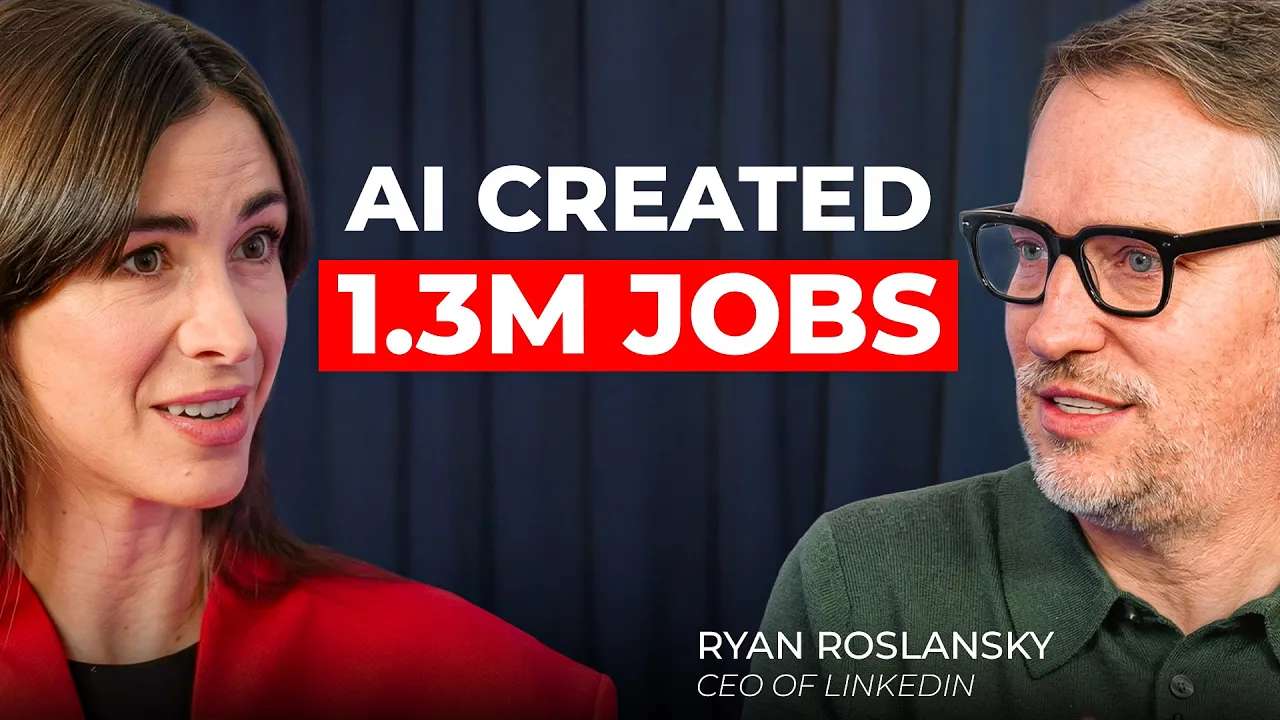
“As it relates to AI, we see something totally different. There's actually been almost, you know, 1.3 million brand new net jobs on LinkedIn for AI roles like data annotators. Um, over 600,000 new data center jobs uh exist on LinkedIn... at least in terms of what we're seeing in the LinkedIn data right now, AI is a net positive addition to the job market, not something that's detracting jobs.”
“It's just been an observation that systems tend to self-adapt and complexify in order to capture work from their environment and dissipate heat. And that is the fundamental driving force behind all of progress, all of quote unquote acceleration, all of everything we see today. It's like gravity. It's, you can argue with thermodynamics, doesn't care, it keeps going.”
Soft skills are a misnomer and are now more critical than technical ones
“just as important on the other side are human skills curiosity creativity courage communication, uh, compassion, the ability to work with other people, the ability to sit down with someone and actually have a conversation. You can't just be mired in using technology in a bubble and be successful. Uh, in a lot of work settings, you have to be able to, you know, disagree and commit with someone... typically called soft skills. I think that's a misnomer. They don't you know soft kind of feels like it's less important. I think they're more important than ever.”
The concept of a linear career path is a data-backed myth
“the reality is in the data there is no such thing as a linear career path. Like it's all over the place. So the more that people first and foremost recognize that you have to take your career into your own hands. There's no natural path that exists that you just get on, I think is is really really important.”
AI Dumerism weaponizes anxiety for political power
“AI-dumerism is just kind of, you know, panicking about, you know, the fact that if there's a system that is too complex, our brains or human brains or generative models can't have a predictive model of them, and so we can't control them. And things we can't control give us entropy about our model of the future, and that induces anxiety. And then AI-dumerism, to me, has been a weaponization of people's anxieties for political purposes.”
Accelerationism responds to rapid technological change
“Rapid technological acceleration has been a fact of a human civilization for about a century and that acceleration is, it's self-accelerating. You can respond by saying it's inevitable. You can respond by saying we have to slow it down, as a lot of people did. And it's just constantly a rapid response to basically the effects of the ideas that were tried to be executed by previous generations.”
“If you take any one bit and you kind of accelerate indiscriminately, then basically you do lose all value. And so, to me, the question is, how do we accelerate intentionally? I think there is a real sense in which we have one shot at this.”
Gen Z is pivoting to trade roles as AI-resilient career insurance
“a real affinity now towards trade roles... especially kind of Gen Z sees as a much safer option. What do you mean trade uh like like firstline jobs um you know typical like trade roles not office jobs and they see those as more resilient in an AI world. These are the types of jobs that AI probably won't take. Uh so we're seeing more affinity towards that as well.”
Seventy percent of professional skills will change by 2030 due to AI
“the types of skills that are necessary for a specific role on LinkedIn have changed north of 25% you know over the last couple years alone. We expect they'll change by 70% by 2030 largely influenced by AI and new tools and new ways of doing these professions. So, um, you know, my, you know, I I often when I talk to people about what they should do with their career, it's it's less about where do you want to be in five years, and it's more about over the next few months, like what new skills do you want to learn?”